The Artist You See Isn’t the Whole Person
There’s a version of every artist that exists before the stage, the album cover, the carefully lit photograph. A person making coffee. Moving through an ordinary morning. Unremarkable in all the ways most mornings are.
And then there’s the other version — the one the world receives.
Understanding the relationship between those two versions might be the most honest entry point into what music actually is.
Persona Isn’t Pretense — It’s Precision
The myth of the unmediated artist — the raw, unfiltered human whose genius pours directly from inner life to listener — is one of popular culture’s most enduring fictions. And it’s worth examining why we’ve held onto it so tightly.
Because what we actually mean when we say we want “authenticity” from an artist is something more specific: we want to feel that the emotional truth is real, even if the presentation surrounding it is constructed. We want the intention to be genuine, even if the execution is deliberate.
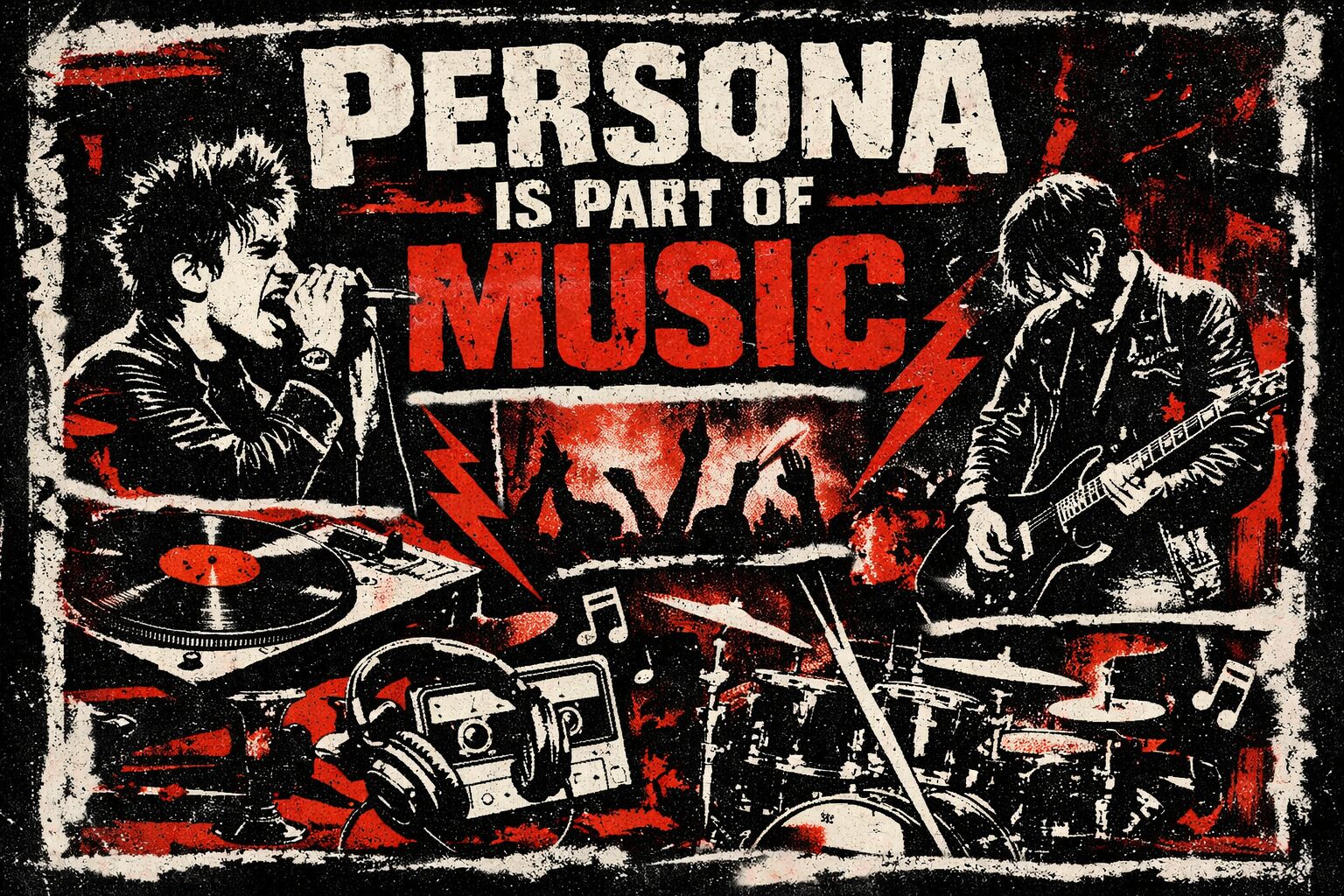
Stage names, alter egos, costumes, mythologies — these aren’t evasions of self. They’re instruments of precision. They allow an artist to isolate and amplify something true about their inner world that ordinary life doesn’t have the resolution to express. The persona becomes a lens. And like any well-designed lens, it reveals more than the naked eye can access on its own.
David Bowie wasn’t hiding behind Ziggy Stardust. He was using Ziggy to say something he couldn’t say as David Jones from Brixton.
The construction was the revelation.
The Studio Has Always Been a Creative Act
The idea that a “pure” recording exists somewhere — an untouched document of a real moment — is equally worth questioning. By the time sound reaches your ears, it has passed through layers of intentional shaping: microphone placement, mixing decisions, compression, mastering, editing. Choices made by producers, engineers, and artists about what should be felt and how.
This isn’t pollution of some original signal. It is the signal.
Modern music production is a conversation between human creativity and technological possibility — and that conversation has been happening since the first time someone realized a recording could be shaped rather than simply captured. The tools evolve. The fundamental act doesn’t: designing an experience for someone who isn’t in the room.
Authenticity as Alignment, Not Absence
Here’s the reframe worth sitting with: authenticity in music was never really about the absence of construction. It was always about the coherence between intention and execution — the sense that every layer of craft, every persona choice, every production decision is pointed toward the same emotional truth.
When that alignment exists, the listener feels it. Not because the scaffolding is invisible, but because it’s working — because the structure is serving something real rather than obscuring it.
The artists who endure tend to be the ones who understood this intuitively. They didn’t resist the tools, the personas, or the craft. They mastered them in service of something they genuinely needed to express.
That’s what intentional artistry actually looks like.
Between Truth and Performance
Music has always lived in the space between documentation and transformation — between what life is and what it could mean if you gave it the right frame, the right sound, the right light.
The persona, the production, the storytelling — these aren’t distractions from the art. They are the art. They’re the means by which ordinary human experience gets exaggerated, dramatized, and shaped into something that can travel across time and context and still land with force inside a stranger’s chest.
The artist you see isn’t the whole person. But that was never the point.
The point was always the world they built — and whether that world has enough truth in it to feel like yours.
No responses yet