Why Story May Become the Next Music Genre
For most of modern music history, we’ve organized music by what it sounds like.
Rock. Hip-hop. Country. Electronic. Jazz.
These labels describe sonic ingredients — the rhythms, the instrumentation, the cultural lineage embedded in a track. They answer one question efficiently: What does this feel like to listen to?
But that question is quietly becoming incomplete.
Something has been shifting beneath the surface of music culture — gradually at first, then all at once. The artists who hold the deepest attention aren’t just crafting songs anymore. They’re constructing environments. Mythologies. Characters. Visual languages and narrative arcs that unfold across years, sometimes across an entire career.
The music remains essential. But it increasingly functions as the emotional language of a larger world — not the world itself.
To understand where this is heading, it helps to look at where it began.
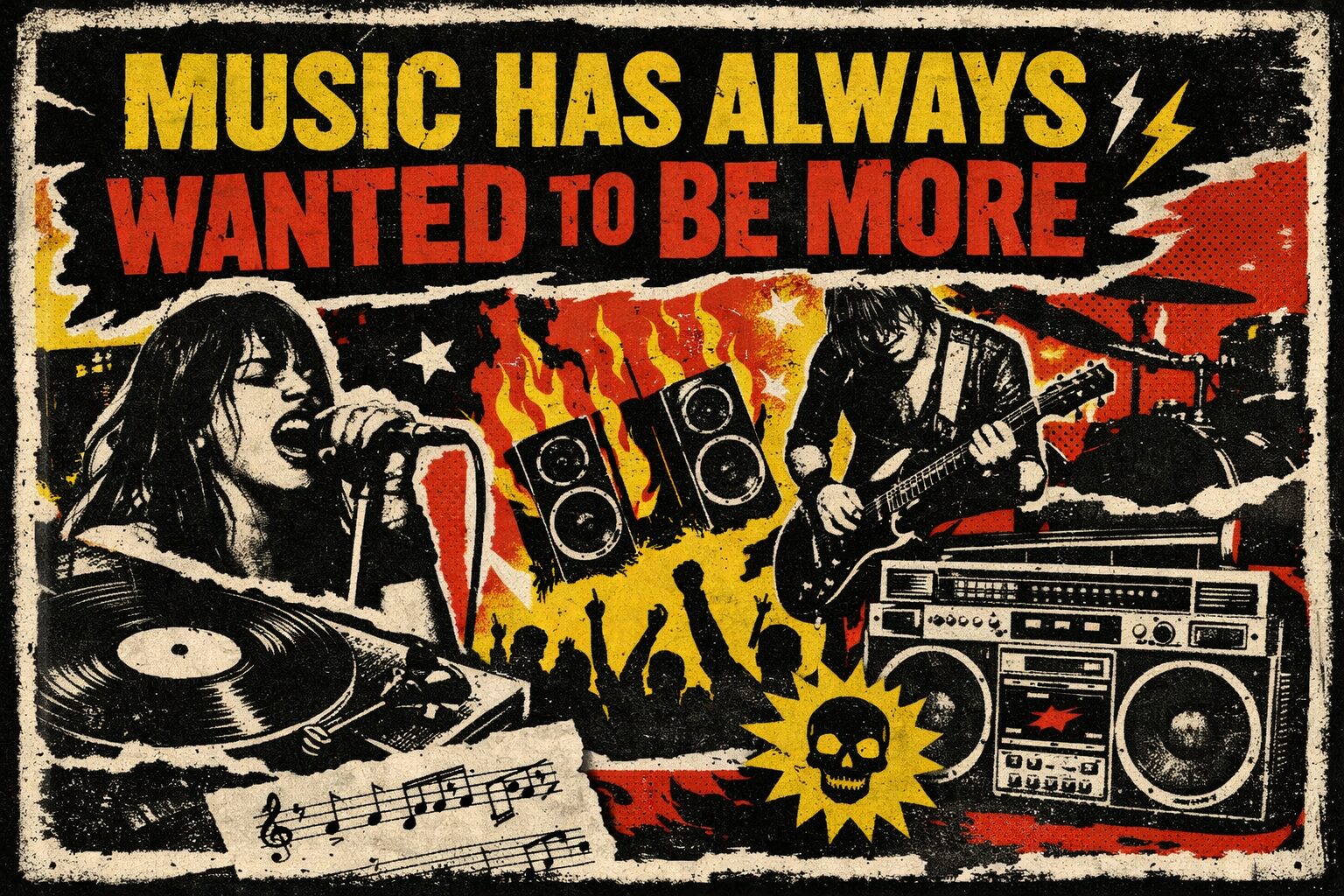
The Historical Arc: Music Has Always Wanted to Be More
The impulse toward worldbuilding in music isn’t new. It’s been there, nascent and persistent, for decades — slowly gathering the cultural and technological conditions it needed to fully emerge.
Pink Floyd understood this instinctively. The Wall wasn’t a collection of songs so much as a structured emotional journey — a descent into psychological isolation told through recurring motifs, character development, and scenes that built toward an inevitable collapse. It later became a stage production, then a film. The world had always been implied in the music; eventually, it simply became visible.
The Who pushed even further with Tommy, constructing a continuous narrative — a deaf, dumb, and blind boy who becomes an unlikely spiritual figure — that demanded to be experienced as story, not just sound. It too migrated outward: stage musical, film, theatrical productions. The music had been a container all along.
Then David Bowie made the next logical move. He didn’t just tell a story — he became one. With Ziggy Stardust, he dissolved the boundary between performer and fictional identity. The narrative didn’t live only in the songs; it lived in the costumes, the interviews, the performances, the carefully constructed mythology of a doomed alien rock star. The artist himself became architecture.
What these artists were all sensing, intuitively, is that music becomes more resonant when it belongs to something larger than itself.
The Modern Evolution: From Persona to Universe
Gorillaz took Bowie’s logic to its conclusion and removed the human artist from the frame entirely. The band is fictional. The members have personalities, backstories, and an evolving lore. Albums feel less like releases and more like transmissions from an ongoing universe — one fans inhabit as much as listen to.
Artists like The Weeknd have carried this further still, structuring albums as chapters in a broader cinematic mythology, with recurring characters and emotional continuity across projects. The music rewards not just listening but following.
What we’re witnessing isn’t a trend. It’s an evolution that was always latent in the art form, finally finding its full expression.
Why Now: The Cultural Conditions Are Ripe
The conditions that have accelerated this shift are worth sitting with.
Streaming made music frictionlessly accessible — and paradoxically, harder to make stick. A new release no longer competes only with other songs. It competes with serialized television universes, immersive games, entire storytelling platforms designed for deep, extended engagement. In that environment, sound alone struggles to hold attention.
Story creates gravity.
When listeners feel that music belongs to a mythology — an unfolding arc, a character’s evolution, a world with its own internal logic — their relationship to it transforms. They’re not simply consuming tracks. They’re following something. They return not because an algorithm surfaced the song, but because they want to see where the world goes next.
Technology has lowered the barrier to building these worlds considerably. What once required the infrastructure of a major label or film studio can now emerge from a small, intentional creative team. The tools for worldbuilding are no longer gatekept. The imagination is the only real constraint.
A New Layer of Artistic Identity
What’s crystallizing, then, is something like a parallel dimension of creative identity — one that operates alongside genre rather than replacing it.
Two artists might both make electronic music. But their worlds — their visual mythology, their character work, the narrative architecture built across releases — could place them in entirely different creative ecosystems. Genre describes the sound. The world describes what the sound belongs to.
This reframes what it means to build a music project entirely. The creator becomes something closer to a world designer: a songwriter, yes — but also a visual storyteller, a creative director, an architect of mythology. Each release carries the weight of something ongoing. Songs aren’t just heard — they’re contextualized.
There’s something almost ancient about this impulse, worth acknowledging. Opera, theater, and oral mythology have always woven music and narrative world together. What’s genuinely new is that independent creators can now build these ecosystems without institutional permission or support. The conditions exist. The audience appetite exists.
The Question That’s Quietly Shifting
The deepest change may be this: for most of the 20th century, music projects were built around people. A band formed. A career evolved. Albums tracked the life and times of an artist.
Increasingly, music projects are being designed around places.
Not just who the artist is, but what world the music belongs to — and whether that world is rich and coherent enough to make you want to return.
If genres once organized music by sound, a new kind of category may be emerging alongside them — one organized by story structure, by the nature of the mythology, by the kind of world the listener is invited to inhabit.
The question listeners are unconsciously beginning to ask is shifting. Less: What does this sound like?
More: What world does this music invite me into — and do I want to live inside it for a while?
That’s a fundamentally different kind of creation. And it may be where the most alive, most enduring music is headed.
No responses yet