
Pop Music’s Invisible Architects
The Brill Building
What the Brill Building Teaches Us About Creativity, Collaboration, and the Stories We Tell
There’s a myth at the center of modern creative culture.
It goes something like this: the truest art comes from a single, sovereign mind. One person. One vision. Unmediated. Unassisted. Authentically, uncomplicatedly theirs.
It’s a compelling story. It’s also largely a fiction. And nowhere does that fiction get more quietly dismantled than in a building on Broadway and 49th Street in New York City, sometime around 1962.
A Room With a Piano and a Desk
The Brill Building didn’t look like a revolution.
It looked like an office. Dozens of small rooms, each containing two things: a piano and a desk. Inside those rooms, songwriting teams arrived each morning the way lawyers arrive at a firm or designers arrive at a studio — with craft to practice, deadlines to meet, and a professional commitment to the work itself.
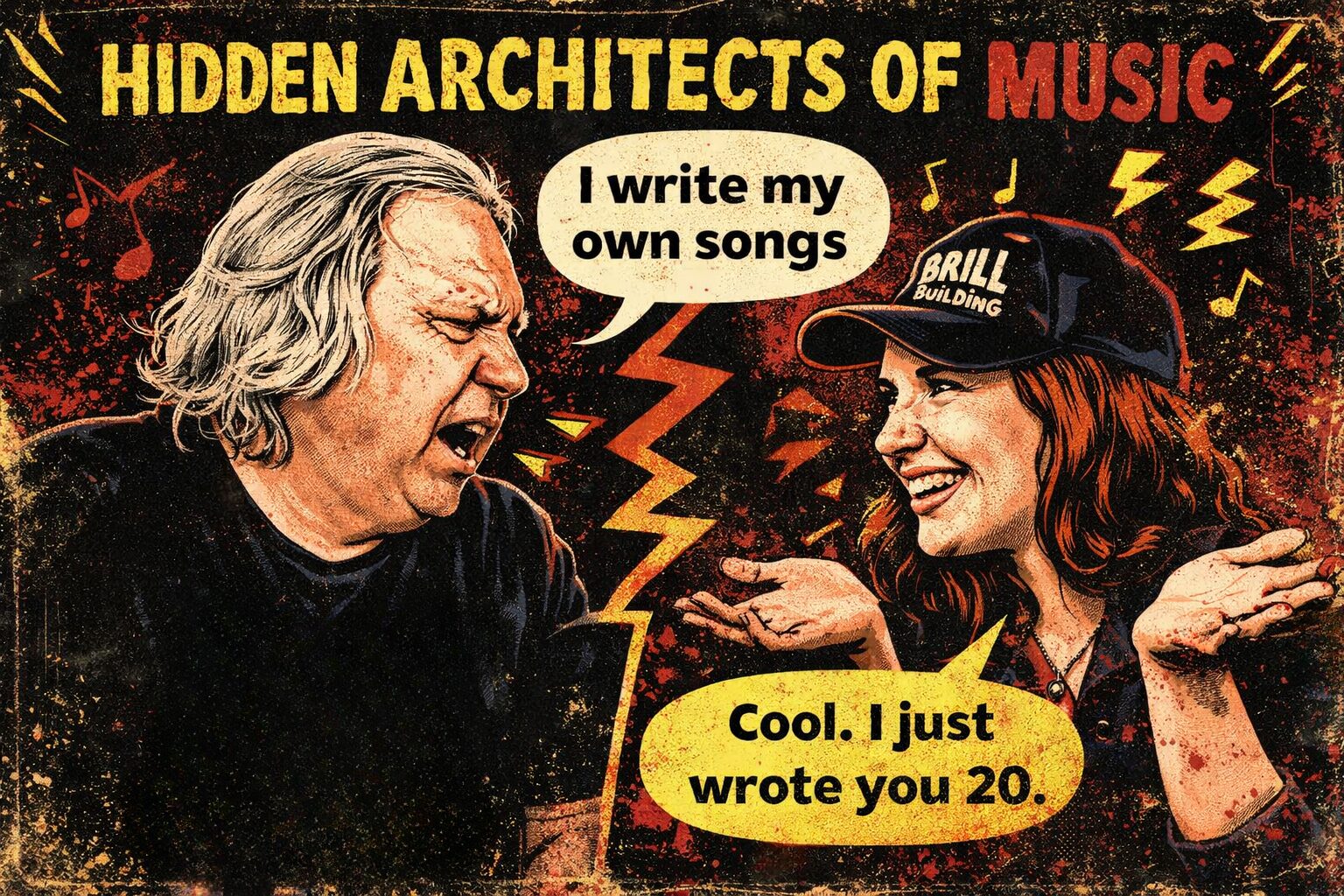
Carole King and Gerry Goffin. Barry Mann and Cynthia Weil. Jeff Barry and Ellie Greenwich. These weren’t tortured lone geniuses waiting for inspiration to strike. They were skilled collaborators operating inside a system — a conscious, structured creative architecture where composition, publishing, and performance were understood to be separate disciplines, each requiring its own mastery.
Songs were written first. Artists were matched to them later. The voice that would carry the material to the world wasn’t necessarily the mind that conceived it.
And out of that system came some of the most emotionally resonant pop music ever recorded.
The System Nobody Questioned — Until They Did
What’s philosophically fascinating about the Brill Building era isn’t just what it produced. It’s what it assumed.
It assumed, without anxiety, that creativity is collaborative by nature. That the songwriter and the performer occupy different creative roles — neither less valid than the other, neither more “authentic.” The person who crafts the emotional architecture of a song and the person who inhabits it vocally are both, in their own way, authors.
Nobody questioned this. Because nobody had been told to.
Listeners heard The Shirelles on the radio and felt something real. The feeling was real. The craft behind it was real. The fact that the song traveled through multiple creative hands before reaching their ears didn’t diminish the experience — it was simply how music was made.
Then something shifted.
The Moment the Story Changed
In the mid-1960s, two forces arrived that would quietly rewrite the cultural narrative around creative authorship.
Bob Dylan. The Beatles.
When artists began writing their own material and performing it — presenting themselves as the unified, singular source of their creative vision — a new idea took hold. The idea that real artists don’t interpret. They originate. That the deepest creative work flows directly from the person whose name is on the record, unmediated by a room full of professional craftspeople in a midtown office building.
It was a powerful idea. It was also, in many ways, a marketing construct dressed up as a philosophical principle.
Because Dylan had collaborators, influences, and sources he drew from deeply — some of which he rarely discussed. The Beatles famously worked with George Martin, whose production architecture was as formative as any Lennon-McCartney melody. The “solitary creator” was always, on closer inspection, a figure shaped by systems, relationships, and inherited traditions.
What changed wasn’t the reality of how music was made. What changed was how the story about music was told.
The Myth of the Lone Creative
This is worth sitting with — because the myth didn’t stay in music.
It colonized the broader culture of creativity. The genius founder. The visionary artist. The lone developer who built something transformative in a garage. These narratives carry enormous psychological weight — they’re compelling, they’re cinematic, and they shape how we evaluate not just art but ourselves as creative people.
If the ideal is the solitary originator, then collaboration can start to feel like dilution. Using tools feels like cheating. Being part of a system feels like inauthenticity.
But the Brill Building was a system. And it made Will You Love Me Tomorrow.
Motown was a system. And it made What’s Going On. The Holland–Dozier–Holland songwriting team crafted many of Motown’s biggest hits.
The question worth asking isn’t did this emerge from a single mind? The question is does it carry something true?
What This Means for How We Think About Making Things
The Brill Building model is, in many ways, a more honest picture of how creativity actually functions — not as a solitary lightning strike, but as a structured, iterative, collaborative practice.
Ideas arrive. They get shaped. They pass through different kinds of intelligence and sensitivity before they reach their final form. Sometimes the person who conceives a thing isn’t the person best suited to execute it. Sometimes the person who executes it transforms it into something the originator couldn’t have imagined alone.
That’s not a compromise of creative integrity. That’s creative integrity working as it was always designed to.
The most generative creative environments — studios, writers’ rooms, design teams, publishing houses — have always understood this intuitively. They build systems for creativity rather than waiting for individual genius to spontaneously appear.
The Brill Building was, in that sense, not just a historical curiosity. It was a model.
The Story We Choose to Tell
What the Brill Building ultimately teaches us is that authenticity in art has always been more complicated than the dominant narrative allows.
The songs were real. The emotions they carried were real. The craft invested in them was real. Whether they emerged from a single consciousness or a collaborative system of professional songwriters, publishers, and performers doesn’t change what they meant to the people who heard them.
What shifted — in the 1960s, and in every era since — wasn’t the nature of creative work. It was the ideology layered on top of it.
And ideologies, unlike music, have expiration dates.
We are living through another version of this conversation right now — about AI tools, about authorship, about what it means to “make” something when the boundaries of human and machine creativity are becoming genuinely difficult to draw. The anxiety is familiar. The questions are old ones wearing new clothes.
The Brill Building doesn’t give us easy answers.
But it does offer a reminder worth carrying:
The stories we tell about creativity shape who feels permitted to create. And when those stories privilege the solitary over the collaborative, the spontaneous over the structured, the “pure” over the assisted — we don’t end up with more authentic art.
We end up with a narrower idea of who an artist is allowed to be.
Which means the most radical thing we might do — now, as in 1962 — is simply to expand the room.
No responses yet